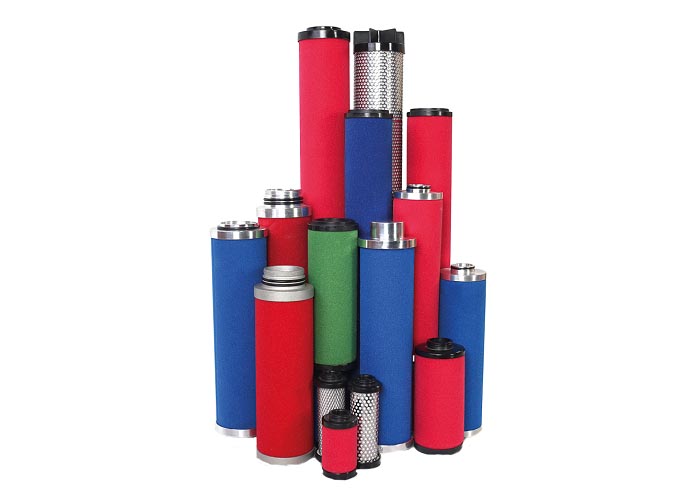
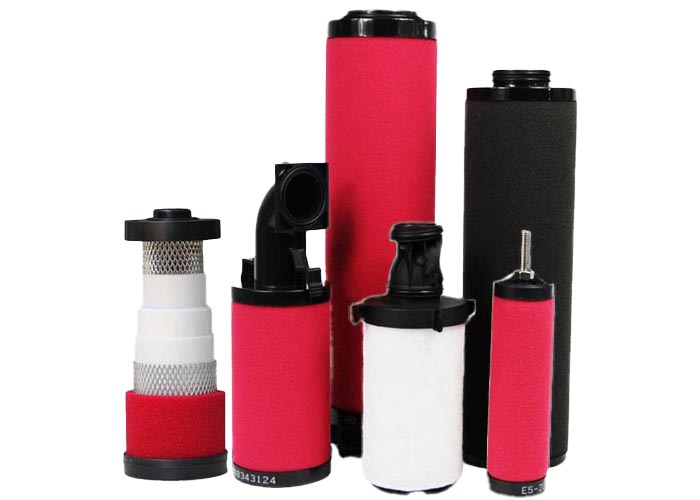
What Is a Compressed Air Filter Element?
A compressed air filter element removes solid particles, oil, moisture and microscopic contaminants from compressed air. These elements are manufactured with a multi-layer structure of borosilicate microfiberglass or other synthetic media to simultaneously guarantee high efficiency and low pressure drop — often referred to in the market as "microfilters." They are used for the final purification of compressed air. Below we first review the components of a compressed air system, then explain why filtration is unavoidable.

Main Components of a Compressed Air Line
-
1
Compressor
Generates compressed air. Primary source of initial contaminants — moisture and oil. -
2
Aftercooler
Primary cooler that condenses water vapour into droplets and reduces air temperature. -
3
Water Separator
Initial separator for bulk water and coarse particles. -
4
Stage Compressed Air Filters
- Pre-filter: removes suspended oil and coarser particles.
- Fine filter: removes very fine particles and oil mist.
- Activated carbon filter: removes odours and oil vapours.
-
5
Compressed Air Dryer
- Refrigerated Dryer: suitable for general-purpose applications.
- Desiccant Dryer: for instrumentation, pharmaceutical and ultra-dry air requirements.
-
6
Receiver Tank
Stores compressed air and dampens pressure fluctuations. -
7
Piping System
Piping that can introduce rust and secondary contamination into the system. -
8
Point-of-Use Filters
Final filters close to the end user to ensure required purity levels are maintained.
Why Must Compressed Air Be Filtered?
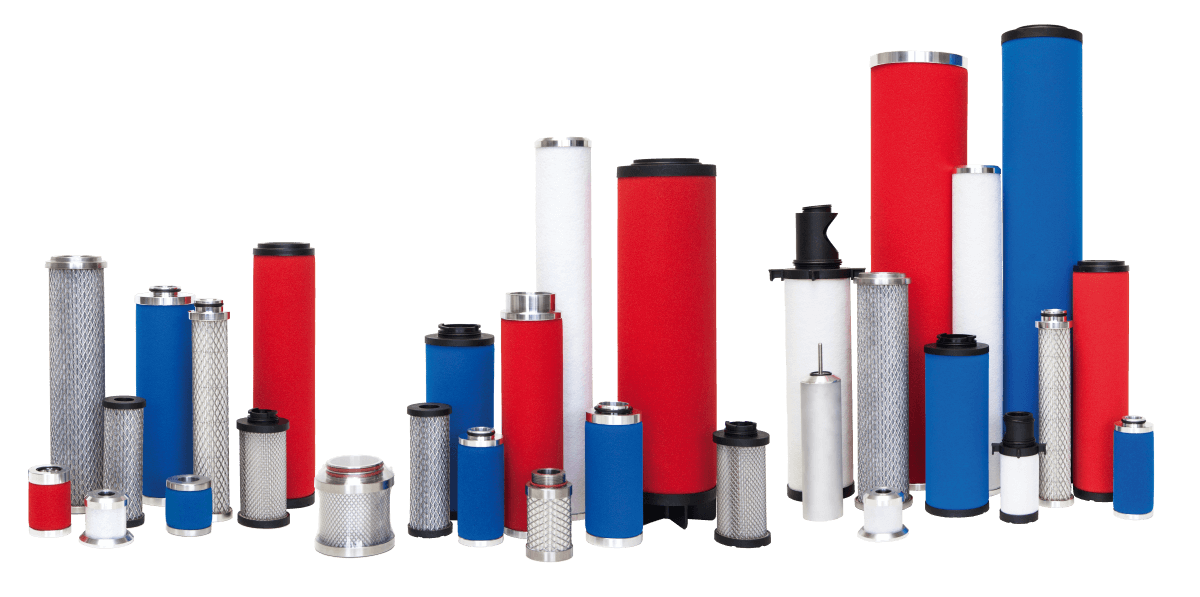
Compressed air is one of the most widely used energy carriers in industry. However, it cannot be used directly after leaving the compressor and must be purified through filtration and drying. The technical reasons are as follows:
1. Increased Contaminant Concentration from Compression
During compression, gas volume decreases significantly — typically to 1/7–1/10 of the original. Since the mass of contaminants (moisture, particles, oil vapour) remains constant, their concentration per unit volume increases in direct proportion to the compression ratio. For example, inlet air at 10 g/m³ humidity compressed to 8 bar reaches ~80 g/m³ — far above the atmospheric dew point, causing rapid condensation.
2. Moisture Condensation as Temperature Drops After Compression
Compression raises air temperature, but downstream stages — aftercooler, piping, pressure drops — reduce it again. This temperature drop condenses water vapour into liquid droplets, and sometimes water-oil emulsions that are corrosive and destructive to pneumatic components.
3. Solid Particles and Oil Aerosols
Compressor inlet air carries suspended particles — dust, soot, metal wear debris. Together with oil aerosols from oil-lubricated compressors, these are present at much higher concentrations after compression and can clog orifices, damage control valves and degrade final product quality.
4. International Compressed Air Quality Standards
ISO 8573-1 defines compressed air quality classes. Most industrial applications — especially sensitive processes such as spray painting, food, electronics and pharmaceuticals — require Class 1–3 for particles, Class 1–2 for moisture and Class 1 for oil, which cannot be achieved without multi-stage filtration and proper drying.
ISO 8573-1 Standard
ISO 8573 is the official benchmark for compressed air quality, specifying required levels for solid particles, moisture and oil. Its key part is ISO 8573-1, which defines the quality classes.
- Solid Particles
- Moisture (Water / Dew Point)
- Oil (Liquid + Mist + Vapour)
Each indicator has defined numerical classes — the lower the number, the higher the quality.
- Class 1: up to 0.1 µm
- Class 2: up to 1 µm
- Class 3: up to 5 µm (general use)
- Class 1: up to −70°C
- Class 2: up to −40°C
- Class 4: up to +3°C (industrial)
- Class 6: moisture limit only
- Class 1: max 0.01 mg/m³
- Class 2: max 0.1 mg/m³
- Class 3: max 1 mg/m³
Class 0 means air quality must exceed Class 1. It applies to ultra-sensitive applications where the permissible contamination level is defined by the user or equipment manufacturer, not a fixed standard value.
Available Production Grades
Specifications of the compressed air filter element grades produced by Sepanta Palayeh Pars:
| Grade | Colour / Structure | Particle Removal (µm) | Max Oil Carryover (ppm) |
|---|---|---|---|
| AC | Metal – mesh coat | 0.01 | 0.01 |
| AA | Red | 0.01 | 0.01 |
| AO | Blue | 0.5 | 0.5 |
| PF | White | 5 | 5 |
Why Sepanta Palayeh Pars?
-
1
Real Expertise in Compressed Air Filtration & Drying
We focus on one domain and execute it thoroughly: correct filter type, the right ISO 8573 class, proper capacity and accurate system design. -
2
Production to International Standards
Products are designed to ISO 8573 quality classes so customers know exactly what purity level they receive. -
3
Consistent and Reliable Quality
Stable materials, genuine-efficiency media and step-by-step quality control keep performance constant throughout the filter's service life, not just in the first days. -
4
Competitive Price Without Quality Compromise
We deliver quality competitive with imported alternatives while keeping the customer's maintenance and replacement costs low. -
5
Fast and Direct Technical Service
Troubleshooting, filter selection, contamination analysis and system monitoring are carried out with speed and precision — customers lose no downtime. -
6
Comprehensive Industrial Support
From food and pharmaceuticals to automotive and instrumentation — every sector's requirements are assessed individually, never with a generic solution. -
7
Long-Term, Plannable Supply
Supply and production planning is maintained consistently so customers never face stock-outs or production shutdowns — replacement elements are always available.
OEM-Quality Replacement Elements for Leading Brands
Sepanta Palayeh Pars manufactures replacement filter elements with quality equal to or exceeding OEM parts for the following brands:
- Abac
- Almig
- Alup
- Atlas Copco
- Beko
- Boge
- Bea
- Compair
- Ceccato
- Donaldson
- Deltech
- Domnick Hunter
- Friulair
- Gardner Denver
- Hankinson
- Ingersoll Rand
- Jemaco
- Kaeser
- Mikropor
- MTA
- OMI
- Parker
- Quincy
- Sullair
- SMC
- Technolab
- Ultrafilter
- Walker
- Worthington
- Zander
- and more…